A loaded truck that will not start is more than a mechanical problem. It can hold up a delivery, leave a driver stranded, delay a concrete pour, or put a piece of jobsite equipment out of service when the schedule has no room to move. A proper diesel truck no start diagnosis separates a simple battery or connection issue from fuel, electronic, air, or engine-related faults before parts are replaced.
The fastest path back to operation is not guessing at the most common failure. It is testing the systems in the right order, confirming what the engine control module sees, and repairing the actual cause of the no-start condition.
Start by Defining the No-Start Condition
The first question is simple: does the engine crank?
A no-crank condition means the starter does not turn the engine, or turns it only intermittently. The fault is usually in the batteries, cable connections, grounds, starter circuit, ignition or start request circuit, safety interlocks, or starter itself.
A cranks-but-won’t-start condition means the starter turns the engine at normal speed, but combustion never begins. That shifts the diagnostic focus to fuel delivery, rail pressure, air intake, engine speed signals, ECM power and communication, injection control, and mechanical engine condition.
That distinction saves time. Replacing fuel filters will not correct a weak battery cable or failed starter relay. Likewise, installing batteries will not restore a truck that is cranking normally but cannot build the fuel pressure required to fire.
Check the Starting and Charging System Under Load
A battery can look acceptable with a meter and still fail when the starter demands high current. Heavy-duty diesel engines require substantial cranking power, especially after sitting overnight, during cold weather, or when the oil is thick and the engine has high compression resistance.
Battery testing should include state of charge, voltage drop, and load performance. Technicians also inspect terminals, crossover cables, grounds, and connections at the starter. In Houston-area service conditions, heat, vibration, corrosion, and road contamination can create resistance inside a cable or connection that is not obvious from a quick visual check.
Voltage drop testing is particularly valuable. A cable may appear intact but lose enough voltage under load to prevent the starter from turning at proper speed. The ECM may also lose stable power during cranking. If module voltage falls too low, the engine may crank without enabling injection.
The start command must also be verified. Depending on the truck, this may involve the ignition switch, start relay, fuse panel, neutral safety switch, clutch switch, body controller, ECM, and starter solenoid circuit. Automated manual and automatic transmissions can prevent cranking when the system does not confirm neutral or sees an active interlock fault.
Diesel Truck No Start Diagnosis Requires Fuel Pressure Data
If the engine cranks normally, fuel system testing becomes a priority. Modern common-rail diesel engines will not start unless they achieve enough pressure for the ECM to command injection. A truck may have fuel in the tanks and still have no usable fuel supply at the injectors.
The diagnostic process begins with basic fuel delivery. Is there adequate fuel in the correct tank? Is a shutoff valve closed? Is the fuel filter restricted? Is there water contamination? Are there leaks, damaged fuel lines, loose fittings, or signs of air entering the suction side of the system?
Air intrusion can cause a hard start or complete no-start after a filter service, tank run-out, or line repair. Proper priming matters. Repeatedly cranking a fuel-starved system can drain batteries and create a second problem without fixing the first one.
After confirming the low-pressure side, a technician checks commanded and actual fuel pressure while cranking. The ECM data helps identify whether the problem is a weak supply pump, restricted pickup, failing high-pressure pump, pressure control valve, leaking injector, faulty pressure sensor, wiring fault, or a condition preventing the system from building pressure.
High-pressure fuel systems are not a place for improvised testing. Diesel fuel under injection pressure can cause severe injury. A qualified technician uses the correct scan data, gauges where appropriate, and safe test procedures rather than loosening high-pressure lines to see whether fuel is present.
Verify ECM Power, Communication, and Critical Sensor Signals
A diesel engine depends on electronic inputs to decide when and how to inject fuel. Even when there is no visible damage and no warning light that seems relevant, the ECM may be missing a signal it needs to start the engine.
Crankshaft and camshaft speed signals are among the most important. During cranking, the ECM needs to recognize engine rotation and position. A failed sensor, damaged connector, rubbed-through harness, or poor ground can leave the engine cranking with no injection event.
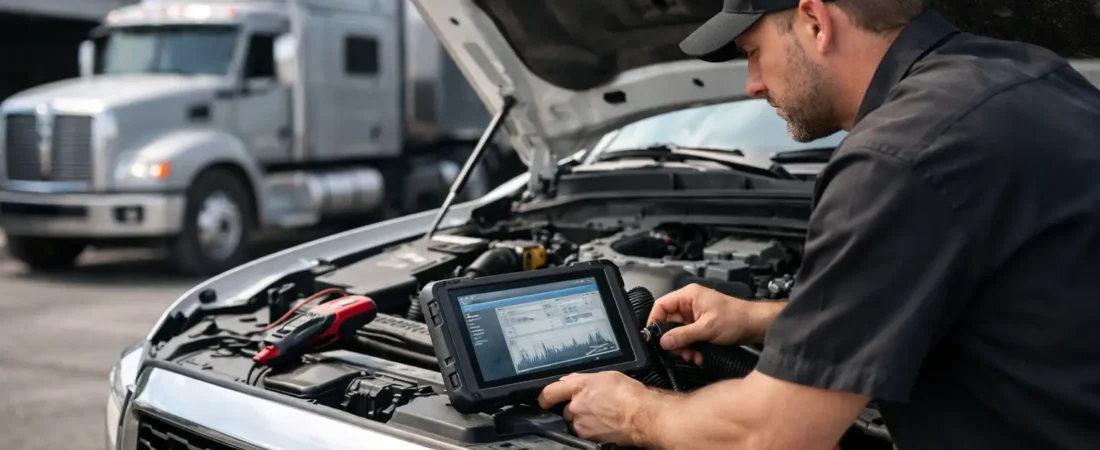
A professional scan tool can confirm whether the ECM is communicating and whether it sees engine RPM during cranking. It can also reveal active fault codes, inactive history codes, sensor readings, commanded fuel pressure, accelerator status, intake readings, and other data that cannot be confirmed by visual inspection alone.
Fault codes are useful, but they are not the diagnosis. A code may point to a circuit, sensor, or system that needs testing. It may also be stored because a different fault caused a low-voltage event or communication failure. Accurate repair comes from matching the code to live data, wiring checks, component testing, and the truck’s actual symptoms.
Do Not Overlook Air, Exhaust, and Mechanical Problems
A diesel engine needs clean air as surely as it needs fuel. A collapsed intake hose, severely restricted air filter, damaged charge-air piping, or blocked intake path can contribute to a no-start or difficult-start complaint. These conditions are less common than battery and fuel issues, but they should not be skipped during a systematic inspection.
Emissions-related faults can also affect starting and operation. Certain DEF, SCR, DPF, or engine protection conditions may trigger derates, warnings, or start limitations depending on the engine platform and fault history. However, it is a mistake to blame the aftertreatment system automatically. The truck still needs complete testing to determine whether an emissions code is the root cause or a result of another electrical or engine-performance problem.
Mechanical issues are less frequent but more serious. Low compression, valve-train damage, incorrect timing, internal engine failure, or an engine that cannot rotate freely can all create a no-start condition. Warning signs may include unusual cranking speed, abnormal engine noise, metal in the oil, a recent overheating event, or a sudden shutdown before the truck would not restart.
Mixer Trucks and Jobsite Equipment Add More Variables
Mixer trucks, vocational trucks, and hydraulic-equipped equipment often have added circuits that can complicate a no-start complaint. PTO controls, body-builder wiring, hydraulic system controls, safety switches, battery disconnects, and auxiliary electrical loads may affect starting voltage, communication, or interlock status.
A truck that starts inconsistently after body equipment is used may have a wiring issue, weak ground, charging problem, or damaged harness associated with the added equipment. The correct approach is to inspect both the chassis and specialized operating systems instead of treating the engine as an isolated unit.
This is especially important when the asset is parked at a batch plant, jobsite, roadside location, or customer yard. Moving it to a shop may not be practical when the immediate need is identifying the fault and restoring operation where it sits.
What Drivers and Dispatchers Can Check Before Service Arrives
A few observations can help speed diagnosis without exposing anyone to unnecessary risk:
- Confirm whether the engine does not crank, cranks slowly, or cranks at normal speed without firing.
- Note any dash messages, warning lamps, clicking sounds, smoke, fuel leaks, or recent repairs.
- Check that battery disconnects are on and transmission or PTO controls are in the proper position.
- Avoid repeated extended cranking, ether use, or opening high-pressure fuel lines.
Providing those details helps a mobile technician arrive prepared with the right test equipment and likely repair parts. AP Diesel Diagnostics performs on-site heavy-duty diagnostic work for trucks and equipment throughout the Houston area, including electrical, starting, fuel, emissions, and specialized mixer-truck system faults.
When a truck will not start, protect the batteries, document the symptoms, and get the fault tested before the next load, pour, or job window is lost.