A truck that will not crank at a delivery site is not always dealing with a bad starter. A mixer drum that will not operate may not have a hydraulic failure. Heavy duty truck electrical troubleshooting identifies where power, ground, communication, or signal is actually being lost so repairs solve the problem instead of replacing good parts.
For fleet operators, owner-operators, dispatchers, and contractors, electrical faults are expensive because the symptoms can be misleading. A weak ground can mimic a failed sensor. Low system voltage can create multiple fault codes. A damaged wire near the frame can shut down a critical circuit only when the truck hits a bump or reaches operating temperature. The fastest repair starts with a controlled diagnostic process.
Why Electrical Problems Create Major Downtime
Heavy-duty trucks depend on electrical systems far beyond the starting circuit. Engine controls, aftertreatment components, transmission controls, air-system sensors, lighting, PTO controls, hydraulic equipment, and onboard communications all require clean power and reliable grounds.
When voltage is unstable or a circuit has too much resistance, the truck may still start and run – until it is under load, operating in wet conditions, or working through vibration. That is why intermittent faults are among the most costly. The issue may disappear when the vehicle arrives at a shop, while the driver is left dealing with repeated no-starts, warning lights, derates, or disabled jobsite equipment.
On mixer trucks and construction equipment, the electrical system often crosses into specialized controls. A failed relay, corroded connector, broken harness, or poor ground can affect drum operation, hydraulic controls, PTO engagement, safety interlocks, or body-mounted lighting. Treating every failure as a mechanical problem can extend downtime and increase repair costs.
Start Heavy Duty Truck Electrical Troubleshooting With the Complaint
A useful diagnosis begins with the exact failure, not just the dashboard code. Is the engine a no-crank, a slow-crank, or a crank-no-start? Does the fault happen after rain, after fueling, during a regen, when engaging the PTO, or only after the truck has been running for an hour? Those details narrow the possible circuits quickly.
A qualified technician will confirm the complaint before clearing codes or disconnecting components. Clearing faults too early can erase information that points to an intermittent issue. Diagnostic trouble codes are valuable, but they are a starting point. A code may identify a circuit or condition without proving that the sensor, module, or component itself has failed.
For example, a low-voltage code at an emissions sensor may be caused by a weak battery, a charging-system problem, connector corrosion, damaged wiring, or a poor shared ground. Replacing the sensor without checking the circuit may get the truck moving briefly, but it does not prevent a repeat breakdown.
Check Batteries, Cables, and Grounds Under Load
Battery condition is the foundation of any electrical diagnosis. A battery can show acceptable voltage at rest and still fail under cranking load. Batteries should be tested individually, especially in multi-battery systems where one weak battery can pull down the entire bank.
Technicians also inspect cable ends, battery disconnects, junction points, starter connections, and frame grounds. Corrosion hidden inside a cable, a loose terminal, or a ground strap with internal damage can create enough resistance to prevent proper starting and charging. On trucks operating around Houston’s heat, rain, jobsite dust, and road grime, connections deserve close attention.
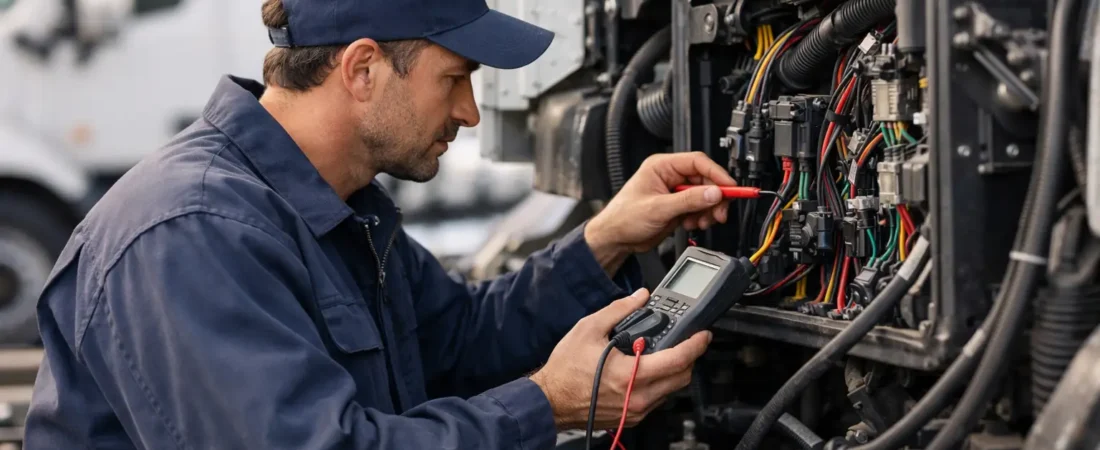
Voltage-drop testing is more useful than simply checking for voltage with a meter. It measures how much voltage is lost across a cable, connection, or ground path while the circuit is working. A circuit can appear normal with no load applied, then fail when the starter, blower motor, hydraulic solenoid, or other component draws current.
Verify the Charging System Before Replacing Parts
An alternator that produces some voltage is not automatically operating correctly. The charging system must maintain the right voltage under normal electrical demand. A truck with work lights, HVAC blowers, lift or PTO controls, electronic engine systems, and auxiliary equipment can expose a weak alternator that looks fine at idle.
The diagnostic process should include battery voltage, charging voltage, alternator output, belt condition, cable integrity, and command or feedback circuits where applicable. Some late-model trucks use smart charging strategies controlled through electronic modules. In those systems, the alternator, battery sensor, wiring, and module communication must be evaluated together.
Overcharging matters as much as undercharging. High voltage can damage batteries, create warning lights, and affect sensitive electronic components. The correct repair depends on test results, not an assumption that the alternator is the only possible cause.
Trace Power, Ground, and Network Communication
Modern heavy-duty trucks use electronic control modules that share information across data networks. When a module loses power, ground, or communication, the result can be a no-start, derate, transmission issue, gauge failure, or a group of unrelated-looking fault codes.
A technician checks fuses and relays, but does not stop there. A fuse can look good while a corroded fuse-box terminal, damaged feed wire, or poor ground prevents current from reaching the load. Relays may click without carrying adequate current. Connectors must be inspected for moisture intrusion, spread terminals, overheated pins, and harness strain.
Data-network diagnosis requires the right scan tool and electrical testing equipment. Modules may report communication faults because of a shorted sensor circuit, damaged twisted-pair wiring, incorrect network resistance, or a module that has lost its power supply. Replacing modules before proving the network and power feeds can add unnecessary cost and programming delays.
Common Electrical Faults That Need Fast Attention
Several electrical problems should be addressed before they become roadside failures:
- Repeated slow cranking, battery warning lights, or batteries that need frequent boosting.
- Blown fuses that return after replacement, especially on lighting, trailer, PTO, or body-control circuits.
- Intermittent engine derates, sensor codes, or aftertreatment warnings that appear with vibration or wet weather.
- Melted connectors, overheated battery cables, or an electrical burning smell.
- Inoperative brake lights, turn signals, marker lights, or trailer connections that create a safety and compliance risk.
These symptoms do not always mean the truck must be towed. Mobile diagnostics can often locate the fault where the asset sits, whether that is a yard, jobsite, roadside location, concrete plant, or customer facility. That avoids the delay and cost of moving an immobile truck before anyone knows what has failed.
Electrical Issues in Emissions and Mixer-Truck Systems
Aftertreatment systems rely on sensors, heaters, dosing components, modules, and wiring. A damaged DEF quality sensor circuit, failed NOx sensor heater circuit, poor SCR module connection, or voltage-related DPF fault can lead to warnings, derates, and eventually a truck that cannot continue operating normally.
These systems should be diagnosed with attention to the full circuit. A failed component is possible, but so are rubbed-through wires near exhaust components, damaged harness routing, corrosion at connectors, and low voltage during key-on testing. The heat around emissions components makes wiring condition especially important.
Mixer-truck electrical troubleshooting also requires an understanding of the equipment side of the truck. PTO circuits, hydraulic solenoids, drum controls, safety switches, and body wiring have to work together. A technician must determine whether the problem is electrical, hydraulic, mechanical, or a combination. That distinction protects production schedules and helps avoid replacing hydraulic components when the command signal is missing.
Information That Speeds Up an On-Site Repair
When calling for service, clear operational details help the technician arrive prepared. Have the truck number, engine make, model year, fault codes, and a description of what happened before the failure. Note whether the truck starts, whether it cranks, any warning messages, recent repairs, and whether the issue is intermittent.
If the truck is loaded, blocking traffic, or affecting a scheduled pour or delivery, say so immediately. The repair plan may change based on safety, access to the truck, available parts, and whether the vehicle can be tested under the conditions that caused the fault.
AP Diesel Diagnostics brings heavy-duty electrical and engine diagnostic capability directly to disabled commercial trucks and equipment in the Houston area. Field-based testing helps identify the failed circuit accurately, complete practical repairs on site when possible, and reduce time lost to unnecessary towing or guesswork.
The best response to an electrical warning is not to keep clearing the code and hope the next trip goes better. Address the first sign of voltage loss, damaged wiring, recurring fault codes, or unreliable starting while the truck is still in a controlled location. A targeted electrical diagnosis today can protect tomorrow’s load, job schedule, and revenue.